A student submits an essay on Monday night. By Thursday, they've opened the gradebook six times. Nothing. By the time the grade arrives, two weeks later, the next essay is already due, and the comments on the first one are a history lesson instead of a lesson.
Nobody in that story did anything wrong on purpose. But the student learned less than they could have. That gap, between what a course promises and what a student actually experiences, is what I mean by education quality.
What "education quality" really means
Quality is a big word. UNESCO makes it part of a global goal: inclusive, equitable, quality education for everyone. Universities use rubrics like the Quality Matters Higher Education Rubric to review how online courses are designed.
Design is half the story. The other half happens during the term, one interaction at a time: a graded assignment, a reply in a forum, a comment that tells a student what to fix.
The research is unusually clear on feedback
In education research, few findings are this consistent. John Hattie and Helen Timperley's review, The Power of Feedback, found feedback to be among the most powerful influences on learning, with an average effect about twice that of a typical schooling intervention. Decades earlier, Chickering and Gamson's Seven Principles for Good Practice in Undergraduate Education listed two that matter here: good practice gives prompt feedback, and it encourages contact between students and faculty.
Timing is part of the quality
The same comment is worth more on Tuesday than three weeks later. Feedback that arrives after the next assignment is due can't change how that assignment is done. Late feedback is still kind; it just isn't as useful.
Why quality slips, and why it's rarely about effort
Anyone who has taught knows the week when the grading pile wins. Faculty juggle several courses, meetings, and a life. Moodle doesn't make it easier to see the whole picture: submissions waiting in one place, forum posts in another, essay questions inside quiz attempts somewhere else. Moodle has a setting for almost everything, but not a single view of "what am I behind on?"
The three misses that matter most
- Work not graded, or graded late. The student waits, and the feedback loses its value.
- Grades without feedback. A number says how it went, not how to improve.
- Questions without a reply. An unanswered forum post tells a student nobody is listening.
What faculty can do
None of this needs a new teaching philosophy. It needs a few habits.
Make response time a promise
Tell students how quickly they'll hear back, for example "assignments graded within five days, forum questions answered within two", and keep that promise. A clear expectation lowers anxiety and makes the follow-through visible.
Work in small batches
Grading ten submissions on Tuesday beats grading forty on Sunday night. Small batches keep feedback timely and keep the comments thoughtful instead of tired.
Use data as a mirror, not a whip
You can't fix what you can't see. A simple, honest view of what's waiting does more for teaching than any guilt-driven reminder.
How EdQ Score helps
That last point is why I built EdQ Score. I've spent years on both sides of the LMS: teaching university courses since 2015, and running Moodle platforms as an LMS manager. I wanted faculty to have that view without exporting a single spreadsheet.
EdQ Score is an open-source Moodle plugin that adds a grading-turnaround dashboard to every course. For the students in an instructor's scope (their own groups, or the whole course for editing teachers and managers), it tracks:
- Assignments: grading turnaround, feedback given, and overdue items
- Forums: reply turnaround and instructor participation
- Quizzes: grading turnaround on attempts with essay questions
It rolls everything into a single EdQ score, plus a "What's affecting your EdQ score" page that lists the exact misses behind it, so the next step is always obvious.
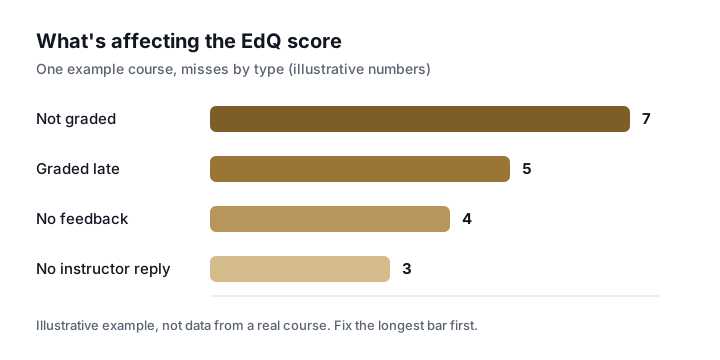
The chart above is an illustrative example. The point isn't the number; it's knowing which bar to shorten first.
For program leads and administrators
What counts as "late" is configurable site-wide, with per-course overrides, including when each clock starts: at submission, at the due date, or at the cut-off date. Two optional daily digests, sent through Moodle's own notifications, can summarize each instructor's score and top misses, and list new submissions from the last 24 hours.
A word of candor: any score can be gamed. A one-word "Good!" technically counts as feedback. Use EdQ Score to start conversations and offer support, not to rank people. Quality grows where faculty feel helped, not watched.
Start small
Pick one course. Agree on reasonable thresholds. Check the dashboard once a week, and fix the longest bar first.
The student from Monday night doesn't need a perfect course. They need to hear back while it still matters.
If you want to try it, the plugin is free on GitHub, and you can see my other Moodle projects. Questions about setting it up for your institution? Ask the AI version of me, or connect with me on LinkedIn.